

Hill Climb Racing 2
Fingersoft
Hill Climb Racing 2 is the kind of racing game I can open for a few minutes and still feel that I have done something worthwhile. It looks simple at first: choose a vehicle, keep it balanced over uneven ground, collect rewards, and try to finish ahead of other drivers. In practice, the combination of physics, short races, upgrades, stunts, and multiplayer competition gives it much more staying power than its cheerful presentation suggests.
Fingersoft has built this sequel around quick decisions rather than complicated controls. You steer with acceleration and braking, but every hill forces you to think about weight, landing angle, fuel, and momentum. A small mistake can turn a promising run into a slow recovery, while a well-timed flip can save time or help you reach a difficult section. The best part is that the game rewards control, not just speed.
It is free to play and suitable for Everyone, which makes it easy to recommend for family play or casual sessions. The trade-off is that optional purchases range from less than a dollar to two hundred dollars per item, so I would approach the economy carefully. The game is enjoyable without treating spending as a requirement, but players who dislike upgrade systems or purchase prompts should know what sort of experience they are choosing.
How the current version feels in everyday play
The current version is 1.70.2, and the game feels like a mature racing title rather than a small experiment. It has been available since November 27, 2016, so its appeal is not based on being new. Instead, it comes from a structure that remains easy to understand while leaving room for practice. The store rating sits at 4.5 from around 4.7 million ratings, and that broad response matches my impression: the basic driving loop is immediately accessible, but mastering it takes patience.
A normal session works well when I have a short break. I can play a race, attempt a challenge, or spend time improving a vehicle without needing to commit to a long campaign. That makes it a good fit for a bus ride, a waiting room, or the few minutes before bed. The short format also makes failure less frustrating than in a long-form racing game. If I roll over near the finish, I usually want to try again rather than close the app.
Related News

Why WhatsApp Messenger Still Makes Everyday Communication Feel Easy

Jurassic World: The Game Is the Better Dino Tycoon for Strategic Players

Threads in Real Life: Who Should Join, Lurk, or Leave

How SHEIN Turned Shopping Into an Endless Content Feed

How to Make Fortnite Feel Smarter on Mobile

Should You Switch to Microsoft Outlook on Mobile?
The main attraction is the terrain. These are not flat circuits where the fastest line is always obvious. Hills, dips, jumps, and awkward landings turn driving into a balancing act. Pressing the accelerator too aggressively can send the front of the vehicle upward, while braking at the wrong time can leave me stranded on a slope. I often find myself making tiny adjustments rather than holding one button continuously.
That physicality gives every vehicle a distinct feel, even when the objective remains similar. A vehicle that seems powerful may be difficult to control over steep ground, while a more manageable choice can produce better results simply because it stays stable. This is one of the first useful lessons I would give a new player: do not judge a vehicle only by its top potential. Consistency matters more when a course contains repeated jumps or sharp changes in elevation.
Why the controls work better than they look
The control scheme is deliberately compact, which is helpful on a phone. I do not need a large collection of buttons or a controller to understand what the game expects. The challenge comes from timing. Acceleration controls forward movement, braking helps manage rotation and landings, and the two actions together create a surprising amount of control in the air.
Gallery
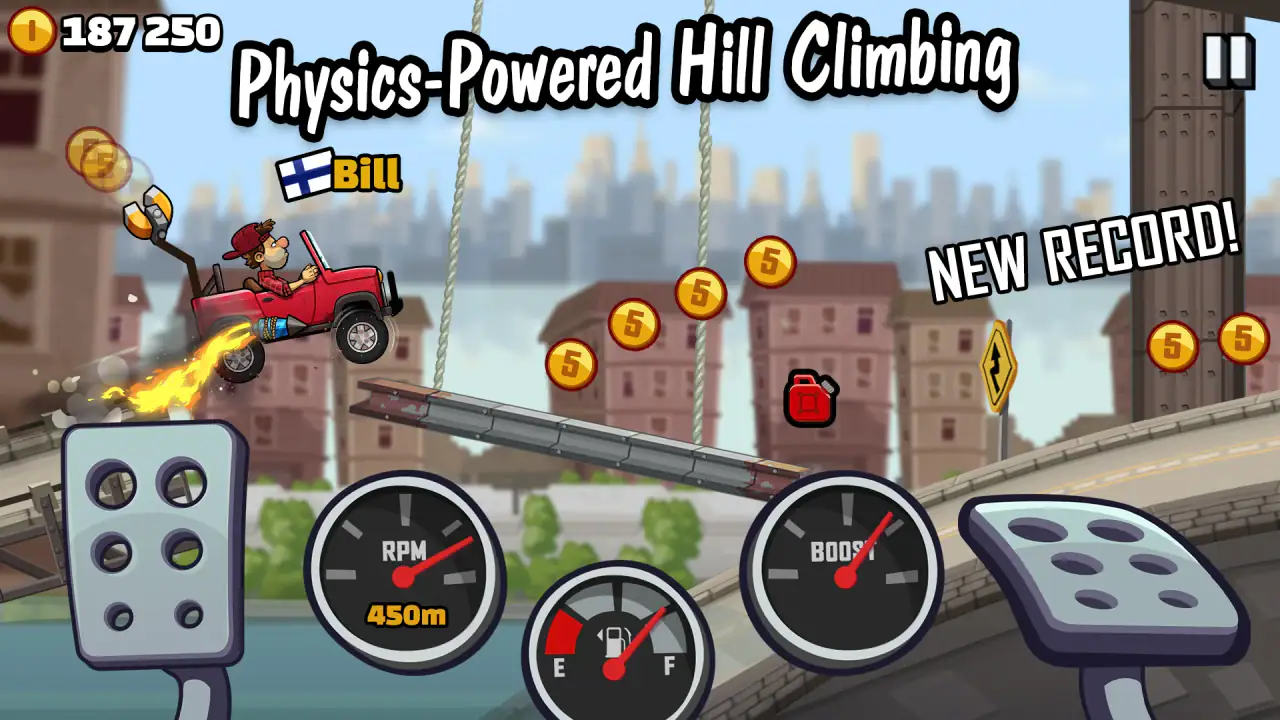
I recommend learning to use the brake as a positioning tool rather than treating it only as a way to slow down. During a jump, a brief brake input can change the vehicle’s attitude and help bring the wheels toward the ground. That is more useful than simply trying to travel as fast as possible. On uneven terrain, a safe landing often saves more time than an aggressive launch.
Another practical habit is to watch the vehicle’s body rather than stare only at the road immediately ahead. The angle of the chassis tells me whether I should commit to acceleration or prepare to correct. This becomes especially important when the screen is moving quickly and the next landing is partly hidden by a rise in the track.
The game is forgiving enough for beginners, but it does not remove the consequences of poor timing. That balance is a major reason it works for different ages. A child can enjoy the jumps and colorful presentation, while a more experienced player can focus on smoother landings, route choices, and competitive times.
Progression, upgrades, and the cost of impatience
Progression gives the races a purpose beyond simply reaching the finish. I can improve vehicles and work toward stronger performance, but the upgrade path also creates a temptation to chase immediate gains. My advice is to avoid spending resources after every disappointing attempt. First identify whether the problem is genuinely vehicle performance or simply a difficult section that needs a different approach.
For example, extra power may help on a long climb, but it can also make the vehicle harder to control on a series of jumps. Better balance or improved handling may be more valuable on a technical course. This is a non-obvious trade-off that new players can miss: an upgrade that looks stronger in isolation is not automatically the best upgrade for the track currently causing trouble.
The free structure is generous enough for players who are willing to progress gradually, but the presence of in-app purchases changes the rhythm. Someone who wants to unlock and improve everything quickly may feel pressure to spend. I would recommend treating purchases as optional convenience rather than part of the basic admission price. Since individual items can cost from $0.99 to $200.00, families should also use the device’s purchase controls and agree on a spending rule before handing the phone to a child.
This is not the right game for someone who wants a completely fixed experience with no upgrade economy. A premium racing game with a single upfront purchase may be a better match for that player. Hill Climb Racing 2 is more suitable for people who enjoy returning regularly, making gradual progress, and deciding how to use limited resources.
Multiplayer pressure without losing the casual feel
The multiplayer side gives the game more energy than a collection of solo time trials would provide. Racing against other players, or competing through structured challenges, changes how I approach familiar terrain. I stop thinking only about staying upright and start considering whether a risky shortcut or faster landing is worth the possibility of a crash.
That tension is effective because races remain short. A loss does not consume a large part of the evening, and a win feels meaningful without demanding the concentration of a full console racing session. The game can therefore serve two different moods: relaxed practice when I want to experiment, or competitive play when I want a clear target.
Still, the competitive layer may not suit everyone. Players who dislike losing progress, comparing performance, or repeating a course until a mistake disappears may find the pressure tiring. I also would not choose it as a substitute for a realistic driving simulator. The appeal comes from exaggerated movement, stunt-like physics, and quick reactions, not from faithfully representing real cars or roads.
A useful routine is to separate practice from competition. I first learn how a vehicle behaves on a difficult hill, then enter competitive races once I understand where it tends to flip or lose momentum. This reduces random failures and makes the multiplayer experience feel more skill-based. It also prevents me from blaming the vehicle when the real issue is an unfamiliar landing.
What the long life of the game means for existing players
Because the game has been around for years and now carries version 1.70.2, existing players are likely to value continuity more than novelty. The core idea remains recognizable: drive across rough terrain, perform controlled stunts, improve vehicles, and compete in brief events. That consistency is useful for returning players because they can pick it up again without relearning an entirely different game.
At the same time, a long-running game can feel busy to someone arriving for the first time. There may be several goals competing for attention, and a new player can easily focus on rewards before understanding the driving fundamentals. I would resist trying to complete everything immediately. Choose one vehicle, learn its behavior, and use early races to develop reliable control. Progress tends to feel clearer once the player has a personal baseline for what counts as a good run.
The game’s large audience also explains why it feels designed for repeated use rather than a one-and-done finish. It has over 100 million installs, which places it among the more established mobile racing experiences. That does not guarantee that every player will enjoy it, but it does indicate that the format has proved durable across a wide range of phones and play habits.
For a returning user, the most important question is whether the current structure still respects short sessions. In my experience, it does. I can make progress without dedicating an entire afternoon, and I can stop after a single attempt without losing the sense that the session mattered. The downside is that the broader progression and purchase options can make the game feel less focused than a simple arcade racer.
Where it falls short compared with other racing choices
Compared with realistic racing games, this one offers far less interest in licensed cars, precise track layouts, or simulation-style handling. That is not a flaw within its own design, but it matters when choosing what to download. If I want to tune a car for a circuit and concentrate on racing lines, I would look elsewhere. Here, the terrain itself is the opponent, and the vehicle’s movement is intentionally exaggerated.
Compared with endless runners, it gives me more control over each mistake. I am not merely reacting to a stream of obstacles; I am managing acceleration, rotation, and landing. That makes the game more satisfying for players who want their improvement to come from understanding physics. An endless runner may be better for someone seeking an even simpler one-thumb distraction.
Compared with premium arcade racers, the free entry is a clear advantage, especially for someone who wants to test the style before paying. The cost is a more persistent progression economy and the possibility of purchase pressure. My preference depends on mood: I choose this game when I want a living, repeatable challenge, but I would choose a paid alternative when I want a clean, uninterrupted package.
There is also a visual and tonal limitation. The friendly presentation makes the game approachable, but players looking for serious competition or dramatic realism may find it too playful. The same bright, stunt-focused character that makes it welcoming can make it feel lightweight to someone expecting a traditional motorsport game.
Small techniques that make a noticeable difference
One technique I find especially helpful is to stop treating every jump as an opportunity for a stunt. A flip can be fun and sometimes beneficial, but a clean landing is usually more valuable than an impressive rotation. I use stunts when the vehicle has enough height and time to recover, not simply because the ramp makes one possible.
I also pay attention to momentum before a climb begins. Starting a steep section with a stable approach often matters more than holding the accelerator harder once the vehicle is already struggling. If the wheels lose contact or the body tilts too far backward, frantic inputs usually make the situation worse. A controlled approach gives the vehicle a better chance of maintaining traction.
When a vehicle repeatedly fails at the same obstacle, I change one variable at a time. I might alter the approach speed, then try a different braking moment, and only afterward consider an upgrade. This turns frustration into useful information. It also helps me avoid wasting resources on a problem that better timing could solve.
For younger players, I would suggest short supervised sessions at first, not because the controls are difficult, but because the purchase system deserves attention. The Everyone rating makes the game broadly accessible, while the optional item range means adults should still set expectations around spending. That is a practical consideration many casual recommendations overlook.
Who should install it and who should pass
I think Hill Climb Racing 2 is a strong choice for players who enjoy physics-based driving, short competitive rounds, and gradual improvement. It works particularly well for people who like the feeling of mastering a difficult section through repeated attempts. It is also a good family-friendly option when the goal is quick entertainment rather than a realistic racing lesson.
I would be more cautious recommending it to someone who dislikes free-to-play progression, wants a complete offline-style package, or becomes irritated by repeated races on familiar terrain. It is also not ideal for a player whose main interest is authentic motorsport. The game’s best qualities come from its playful handling and stunt-friendly courses, so those looking for realism should choose a different category of racer.
Device compatibility is reasonably accessible for modern users because the minimum requirement is Android 7.0, though the experience will still depend on the individual phone and its condition. I would keep the game updated when possible, particularly for a long-running title whose current version is 1.70.2. Existing players should watch how updates affect progression balance and competition, while new players should focus first on whether the basic physics feel enjoyable before investing time or money.
My recommendation after spending time with it
What keeps me coming back is not the promise of a perfect race. It is the small satisfaction of correcting one mistake: landing with the wheels down, carrying enough momentum over a climb, or choosing not to force a stunt. Those moments make the game feel more thoughtful than its cartoon-like surface suggests.
The free price makes trying it easy, and the Everyone rating broadens its audience. Fingersoft has also preserved a clear identity: this is a racing game about terrain, balance, and repeatable challenges rather than realism. Its current version feels like the continuation of an established mobile experience, not a reinvention, which should reassure returning players who already enjoy its rhythm.
My final advice is to play patiently and keep the purchase system in perspective. Start with the controls, learn how each vehicle reacts, and upgrade according to the obstacle rather than chasing the biggest-looking improvement. If that loop sounds appealing, this is an easy game to recommend for short daily sessions. If you want a premium racer without ongoing progression decisions, or a serious simulation with realistic handling, I would skip it. For everyone else, Hill Climb Racing 2 remains a lively, accessible racer whose real depth appears when you stop fighting the hills and start reading them.
FAQs for Hill Climb Racing 2
What is Hill Climb Racing 2 and how does it differ from the original?
Hill Climb Racing 2 is a sequel to the popular physics-based driving game, Hill Climb Racing. This version offers enhanced graphics, new vehicles, and multiplayer capabilities, allowing players to compete against others in real-time. It also includes customizable characters and vehicles, as well as new adventure and challenge modes, enhancing the overall gameplay experience.
What are the system requirements for Hill Climb Racing 2 on Android and iOS?
For Android users, Hill Climb Racing 2 requires Android 4.4 or later, while iOS users need iOS 9.0 or later. The game is optimized for both smartphones and tablets. Ensure you have sufficient storage space and a stable internet connection to enjoy the multiplayer features seamlessly.
Is Hill Climb Racing 2 a free-to-play game, and does it include in-app purchases?
Hill Climb Racing 2 is free to download and play, but it does offer in-app purchases. These purchases range from currency packs to unique vehicle upgrades and customization options. While these can enhance gameplay, they are not necessary to progress, allowing players to enjoy the game without spending money.
How can I earn coins and gems in Hill Climb Racing 2?
Coins and gems can be earned by completing races, winning events, and achieving challenges. Players can also collect daily rewards and watch optional ads for extra coins. Gems, being the premium currency, are rarer but can be obtained through special events or purchased directly via in-app purchases.
What multiplayer features are available in Hill Climb Racing 2?
Hill Climb Racing 2 offers several multiplayer features, including friendly matches and competitive races against players worldwide. The game features a league system where players can climb ranks by winning races. Engaging in multiplayer modes provides the opportunity to earn exclusive rewards and showcase driving skills on a global platform.
Pros
- Engaging and addictive gameplay.
- Smooth controls and physics.
- Wide variety of vehicles.
- Customizable character outfits.
- Frequent updates with new content.
Cons
- In-app purchases can be pricey.
- Requires internet for some features.
- Ads can be intrusive at times.
- Progression can feel slow.
- Graphics are simple
- not realistic.


